
Responses to communication signals in the avain Medial Suprior Olive (n. laminaris).
Principle Investigator: Dr M Fabiana Kubke
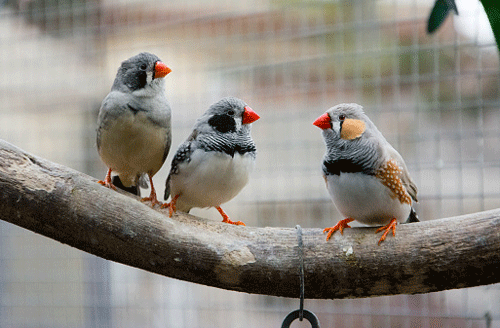
Understanding how the auditory system is able to process speech signals is of crucial importance for the amelioration of the effects of hearing disabilities on social interactions. Speech is unique among other sounds in that it plays a significant role in social interactions. Songbirds, and in particular zebra finches, have proved to be an ideal animal model for the processing of human speech sounds as the neural mechanisms and neuronal circuits that underlie song learning show many parallels with the neural circuits that mediate speech learning and production in humans.
This study will examine the activity of neurons in the region of the brain that is important for sound localisation. Zebra finches to not perform well when behaviourally challenged to localise sound and their neurons do not exhibit the same features of activity as other animals that perform well on these tasks. It is hypothesised that the activity of these neurons in zebra finches has evolved to allow processing of vocal features of sound. This will provide important insight to how humans process speech sounds.